


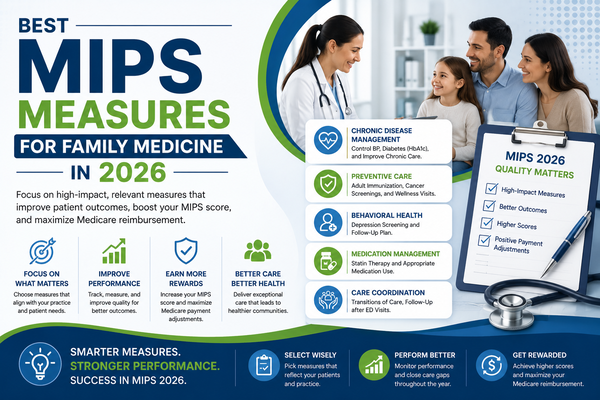
Best MIPS Measures for Family Medicine in 2026
The Merit-based Incentive Payment System (MIPS) the performance-based track of the CMS Quality Payment Program (QPP) offers family medicine one of the program's most extensive sets of specialty measures: 62 MIPS quality measures from which to choose. This presents both an advantage and a potential pitfall. With so many options, it is tempting to simply select the measures that your electronic health record (EHR) system extracts most easily, rather than choosing those that truly reflect your patient population's characteristics and enable a strong score against the MIPS 2026 benchmarks. Below, we explain how to approach measure selection for the MIPS reporting 2026 performance year and identify the measures best suited to family medicine practices.
The Baseline Rule: Six Measures, One Outcome or High-Priority
Under the traditional MIPS program, the Quality category which accounts for 30% of your total score requires the selection of six measures; at least one must be an outcome measure or another high-priority measure. You must report data on a significant proportion of your eligible encounters throughout the entire performance year and across all payers; this ensures your score is evaluated against MIPS 2026 national benchmarks, thereby avoiding a score reduction due to incomplete data. Measure selection depends not only on relevance to your specialty but also on choosing measures for which your practice has a sufficient volume of eligible cases to ensure meaningful and consistent reporting.
Strong Measure Options for Family Medicine in 2026
Controlling High Blood Pressure (Measure #236): A high-priority intermediate outcome measure that tracks the percentage of hypertensive patients aged 18 to 85 whose most recent blood pressure reading was below 140/90 mmHg. It is one of the most widely used measures in family medicine, as hypertension management is fundamental to primary care consultations and meets the requirement of including a high-priority outcome measure within the set of six measures used in most practices.
Preventive Care and Screening: Screening for High Blood Pressure and Follow-Up Documented (Measure #317): Track whether adult patients were screened for hypertension and provided with a documented follow-up plan based on the measurement results. This naturally complements Measure No. 236 for practices with a large population of hypertensive patients; however, most centers should choose one measure or the other rather than both to avoid a duplicative documentation burden that adds no value to the score.
Preventive Care and Screening: Tobacco Use Screening and Cessation Intervention (Measure #226): It measures whether adult patients were screened for tobacco use and whether, upon being identified as users, they received a smoking cessation intervention. Workflows for tobacco use screening are already integrated into most primary care practices, facilitating the systematic collection of this measure over a full year of visits.
Preventive Care and Screening: Body Mass Index (BMI) Screening and Follow-Up Plan (Measure #128): It tracks BMI records and follow-up plans when the BMI falls outside normal ranges. Like tobacco use assessment, this practice is typically already integrated into intake workflows, facilitating accurate reporting.
Preventive Care and Screening: Screening for Depression and Follow-Up Plan (Measure #134): It tracks whether patients aged 12 and older were screened for depression using a standardized tool, including a documented follow-up plan for cases with a positive result. Behavioral health integration is an area of growing interest, and this measure appropriately reflects that shift for practices already using standardized screening tools.
Preventive Care and Screening: Unhealthy Alcohol Use Screening & Brief Counseling (Measure #431): It complements the set of preventive care measures and works well alongside tobacco and depression screening in facilities with robust screening workflows at intake.
Documentation of Current Medications in the Medical Record (Measure #130): Track whether a complete medication list was documented during the consultation. This measure features updated specifications for 2026; therefore, facilities that have reported it in previous years must confirm that their workflow still aligns with the current definition before relying on historical performance data.
Choosing Measures for Volume, Not Just Relevance
The fact that a measure is clinically relevant to family medicine does not automatically make it the right choice for your practice. The best decisions regarding which measures to select come from weighing clinical relevance against actual claims history specifically, ensuring you have enough patients meeting the denominator criteria to generate a statistically significant performance rate that is comparable to CMS benchmarks. Relying on a measure that captures only a small number of eligible encounters per year carries more risk than relying on one with a steady monthly volume, even if the lower-volume measure appears more clinically significant to your practice's identity.
Consider Whether an MVP Fits Your Practice
Starting in the 2026 performance year, practices may choose to report data via a MIPS Value Pathway (MVP) instead of the traditional MIPS system. While MVPs remain optional, they offer a more targeted, specialty-aligned set of measures, sparing practices from having to select from the 62 measures that make up the full family medicine set. For single-specialty family medicine practices that have struggled to select measures or achieved inconsistent scores under the traditional MIPS system, an MVP is worth considering; CMS has indicated that MVPs represent the program's long-term direction, so becoming familiar with them now offers real strategic value.
Don't Overlook Improvement Activities That Complement Your Measures
Improvement Activities (IA) account for 15% of your score; selecting activities that reinforce your chosen quality measures can strengthen the overall narrative of your reports. Activities such as providing care team members with 24/7 access to the patient's medical record, or checking the state prescription drug monitoring program before prescribing controlled substances, naturally complement a measure set focused on chronic disease management and preventive screenings.
The Takeaway
With 62 eligible measures, family medicine enjoys greater flexibility than almost any other specialty in the MIPS program; however, that flexibility is only beneficial if leveraged deliberately. The most robust measure sets for 2026 combine genuine clinical relevance, sufficient patient volume for consistent reporting, and at least one outcome or high-priority measure that reflects actual chronic disease management rather than serving merely as an easy-to-meet requirement. Reviewing your claims history against selected measures before the performance year is too far underway gives you the best chance of achieving a score that accurately reflects the care you actually provide.
ESOFTX, Inc. helps family medicine and primary care practices select, monitor, and MIPS reporting services with precision and confidence. If you would like assistance reviewing your 2026 measure selection based on your claims history, we would be happy to help.
