


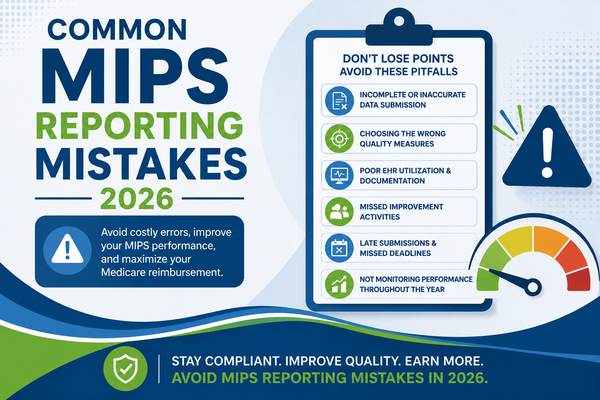
Common MIPS Reporting Mistakes to Avoid in 2026
CMS has designated 2026 as a "year of stability" for the Merit-based Incentive Payment System (MIPS). Category weights remain unchanged Quality (30%), Cost (30%), Promoting Interoperability (25%), and Improvement Activities (15%) and the performance threshold holds steady at 75 points through 2028. However, program-level stability does not mean the reporting process has become any simpler. In fact, small, avoidable errors carry heavier penalties than ever in 2026, as the measure inventory has shifted, documentation requirements have tightened, and there is less leeway to attribute a poor score to a "new standard."
Below, we outline the most common errors we see when practices prepare their MIPS submissions, along with ways to correct course before the deadline.
1. Reporting Retired or Substantively Changed Measures
CMS periodically retires quality measures that have reached a performance ceiling, are difficult to compare, or have become clinically obsolete; the 2026 performance year is no exception. Several previously used measures have been eliminated or substantially modified for this performance year.
Practices that retain last year's measures without verifying the current inventory risk reporting a measure that no longer exists or one with new specifications that their electronic health record (EHR) system is not capturing correctly. Before the reporting period begins, cross-reference each measure you plan to submit with the current year's specifications, rather than relying on a saved list from a previous year.
2. Treating Promoting Interoperability as a Checkbox
The Promoting Interoperability (PI) category retains a 25% weighting, and CMS continues to raise the bar for documentation regarding security and governance. A common mistake is completing the Security Risk Analysis (SRA) attestation without truly aligning underlying risk management activities with current HIPAA Security Rule requirements, or submitting an outdated SAFER Guide self-assessment. An attestation that does not match actual documented practices raises a red flag during an audit; it is not merely a risk to your score.
3. Ignoring MIPS Value Pathways (MVP) Eligibility Changes
MVP reporting remains optional for most practices in 2026, but the rules regarding who can report as a group have changed. Multispecialty groups can no longer register or report an MVP as a single consolidated group; they must do so at the subgroup level, the individual level, or as an APM entity. Practices that assume the previous year's group registration process still applies could find their MVP submission invalidated. If your practice is multispecialty and is considering adopting MVPs, verify the subgroup requirements well in advance, rather than during the submission week.
4. Underestimating the Improvement Activities Update
The Improvement Activities inventory has changed for 2026: new activities have been added, several have been removed, and the scope of some has been modified. A common mistake is continuing to report an activity that has been retired or restructured, which can invalidate points in a category often considered the "easy" 15%. Improvement Activities should be reviewed against the current inventory with the same care as quality measures.
5. Weak or Inconsistent Data Validation Before Submission
The most significant change for 2026 lies not in the measures themselves, but in the rigor with which CMS evaluates data quality. Poorly configured workflows in electronic health record (EHR) systems, inconsistent recording of structured data, and incomplete capture of numerators and denominators quietly undermine scores, even when the appropriate measures have been selected. A correctly chosen measure that is documented inconsistently across different providers or visit types will yield poor results. Conduct internal data validation checks well before the submission deadline, not after.
6. Missing the Cost Category Entirely
The cost component accounts for 30% of the score and is calculated automatically by CMS based on claims data, so no direct submission is required. This also makes it the category that practices often overlook until they receive their final score. Reviewing cost feedback reports throughout the year rather than just after the evaluation period ends helps identify utilization patterns that should be addressed before they impact the score.
7. Waiting Until the Deadline to Reconcile Everything
Given that 2026 introduces a mix of retired measures, updated improvement activities, new wording for PI (Patient Information) certification, and rules for MVP subgroups, practices that wait until the final weeks to reconcile these four categories often discover discrepancies when it is already too late to correct them. Conducting a mid-year review to confirm measure validity, certification accuracy, and data integrity allows the practice to resolve issues rather than simply documenting them.
The Takeaway
For 2026, the MIPS program rewards practices that treat reporting as an ongoing discipline rather than an end-of-year task. While the program's overall structure remains largely unchanged, specific details do shift and it is precisely in these details that points are often lost. Proactively reviewing measures, attestations, and documentation now, rather than at the time of submission makes the difference between a neutral adjustment and receiving a tangible financial incentive.
ESOFTX, Inc. helps practices manage reporting requirements for MIPS, PCMH, HEDIS, and value-based care models with precision and confidence. If your team needs a second opinion on your MIPS 2026 strategy, we are here to help.
