


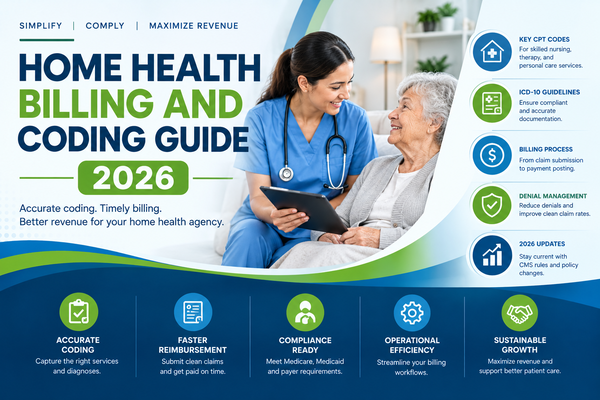
Home Health Billing and Coding Guide 2026
Home health billing does not operate like standard fee-for-service medical billing. Payment is not determined on a visit-by-visit basis but is instead established based on a 30-day period of care, with the cost determined almost entirely by the clinical and functional profile reflected in the OASIS assessment conducted on day one. If the assessment is performed correctly and the appropriate code is assigned, the period is billed accurately; if an error occurs, the agency must absorb the difference for the entire 30-day period. The following explains how home health billing and coding actually work under the Home Health Prospective Payment System (HH PPS) rules for the 2026 calendar year.
The Foundation: PDGM and the 30-Day Period
Home health services are reimbursed under the Patient-Driven Groupings Model (PDGM), which replaced the former visit-volume-based payment system with a case-mix model grounded in clinical characteristics. Instead of paying more simply for a higher number of visits, the PDGM sets the price for each 30-day period of care based on the patient's admission source, clinical grouping, level of functional impairment, and comorbidity adjustments; all these factors are derived from the OASIS assessment and the diagnosis codes reported on the claim.
This means that coding accuracy at the start of a period is not merely an administrative formality, but the mechanism that determines the payment for the subsequent 30 days.
Step 1: The Notice of Admission (NOA)
Every home health care period begins with a Notice of Admission (NOA), which must be submitted within five calendar days of the start of care. The NOA establishes the official start date for Medicare billing purposes and sets the definitive reference point for services provided during the period; once the NOA is accepted, no other home health agency may bill Medicare for services to that patient until a discharge is reported. Late submission of NOAs carries real financial consequences: Medicare reduces payment for each day that elapses between the start of care and the actual submission of the NOA, making this process one of the simplest ways to protect revenue something agencies can almost entirely control through workflow discipline.
Step 2: OASIS Assessment and HIPPS Code Generation
The Outcome and Assessment Information Set (OASIS) is completed at the start of care and determines the entire payment calculation. Clinical responses are used to generate a Health Insurance Prospective Payment System (HIPPS) code; this is a five-character code that serves as a concise summary of the patient's clinical group, level of functional impairment, and comorbidity adjustment, all integrated into a single figure. Medicare does not require the full clinical narrative to process the claim; the HIPPS code reported under revenue code 0023 is sufficient for the payment calculation to be performed automatically. An inaccurate response in the OASIS not only affects the quality of the documentation but can also completely alter the HIPPS code and, consequently, the payment for the entire 30-day period.
Step 3: Diagnosis Coding and Clinical Grouping
The PDGM classifies each period into one of several clinical groups based on the reported primary diagnosis; these categories include wound care, complex nursing interventions, neurological or post-stroke rehabilitation, and MMTA (medication management, teaching, and assessment). The primary diagnosis must be coded with sufficient specificity to ensure correct assignment to one of these groups; vague or non-specific ICD-10 coding carries the risk of the claim being assigned to an unintended and often lower-paying clinical group. Coding for comorbidities is also important: comorbidity adjustments (whether low or high) increase payment above the clinical group's base rate when qualifying secondary diagnoses are properly reported and documented.
Step 4: Revenue Codes and HCPCS Reporting
Home health care claims include revenue codes alongside HCPCS codes to accurately identify the discipline that provided each service for example, code 042X for physical therapy, 043X for occupational therapy, and 055X for skilled nursing. HCPCS codes for non-drug supplies and items are updated twice a year, while drug-related codes are updated four times a year; consequently, coding references that were accurate at the start of the calendar year may become obsolete well before the next one begins. Linking the correct revenue code with the appropriate HCPCS code enables the Medicare system to correctly classify each service line within the corresponding period.
Step 5: LUPA Thresholds Know Where They Sit for 2026
The Low-Utilization Payment Adjustment (LUPA) applies when the number of visits within a 30-day period falls below a minimum threshold, converting the payment originally based on the full case-mix rate into a lower per-visit payment. CMS updated the LUPA thresholds for the 2026 calendar year using more recent claims data; these thresholds vary by PDGM payment group, meaning the number of visits required to avoid a LUPA in one clinical group will not necessarily be the same for another. Verifying the current thresholds for each payment group, rather than relying on figures from previous years, helps prevent periods from inadvertently falling into the LUPA category.
What Changed for CY 2026
The Home Health Prospective Payment System (HH PPS) final rule for calendar year 2026 (CMS-1828-F), published on November 28, 2025, introduced several adjustments that agencies must incorporate into their billing workflows:
- A 2.4% home health payment update, offset by a permanent -1.023% behavioral adjustment linked to behavior related to the implementation of the PDGM during the 2020–2022 period
- A temporary -3.0% adjustment it applies specifically to payments for the 2026 calendar year as part of the ongoing reconciliation between previously estimated and actual expenses—a one-year reduction that does not carry over to the initial rate for the 2027 calendar year.
- A net aggregate payment decrease of approximately 1.3% (roughly $220 million) across the entire sector compared to the 2025 calendar year, even though the update to the base market basket is positive in itself
- Recalibrated PDGM case-mix weights and updated LUPA thresholds, both based on more recent claims data
- Two distinct base payment tiers depending on compliance with quality reporting requirements: agencies that meet the standards of the Home Health Quality Reporting Program (HH QRP) receive the full payment rate associated with quality compliance, whereas those that fail to meet reporting requirements face a 2-percentage-point reduction in the "market basket" update a difference that applies to every claim submitted during that year.
The practical takeaway is that, technically, base rates increased prior to the adjustments; however, the combined effect of temporary cuts and those linked to performance means that most agencies will experience a modest net decrease per period in 2026. This year, coding accuracy and full compliance with quality reporting requirements are more important than ever, simply to maintain stable revenue in the face of these adjustments.
Common Billing Mistakes That Cost Agencies Revenue
- Late NOA submission Even a delay of a few days results in a permanent and unrecoverable reduction in payment corresponding to those days.
- Imprecise OASIS documentation which underestimates functional impairment or clinical complexity, resulting in a HIPPS code with a lower financial valuation than the care actually provided.
- Non-specific principal diagnosis coding which erroneously assigns a period to the incorrect PDGM clinical group
- Missed HH QRP reporting deadlines, activate the reduced payment rate for the entire following year
- Visit-count miscalculation near LUPA thresholds, unexpectedly converting a period that would otherwise be standard into a lower pay-per-visit rate
The Takeaway
Home health billing rewards accuracy at the beginning of the period far more than most other billing models. The submission of the NOA, the OASIS assessment, the resulting HIPPS code, and accurate diagnosis coding all occur during the initial days of care, and each of these elements determines the payment for the subsequent 30-day period. As phased-in rate adjustments for the 2026 calendar year squeeze margins across the industry, consistently executing these initial steps correctly makes the difference between agencies that protect their revenue and those that quietly lose it claim after claim.
ESOFTX, Inc. helps home health agencies safeguard their revenue under 2026 calendar year regulations through accurate PDGM coding, billing workflows driven by OASIS data, and compliance with HH QRP requirements. If you would like a review of your current home health billing process, we would be happy to assist you.
