
How Small Practices Can Obtain PCMH Recognition: A Step-by-Step Guide
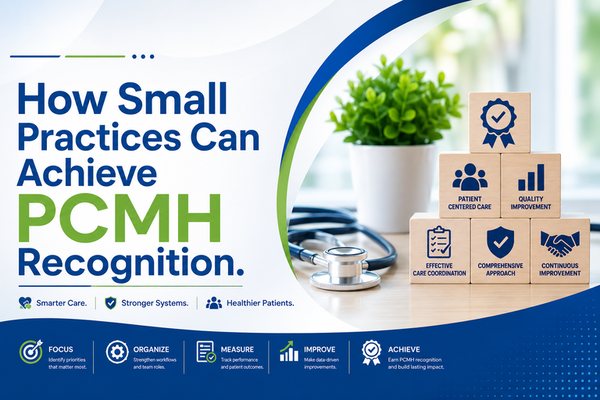
NCQA recognition as a Patient-Centered Medical Home (PCMH) is one of the clearest ways for a small primary care practice to demonstrate its commitment to coordinated, patient-centered care, while also opening the door to value-based contracting opportunities. However, with the various concepts, criteria, credits, and Q-PASS logins involved, the process can seem daunting to a practice without a dedicated quality department. In reality, it is not. The following describes the process step-by-step, broken down into manageable stages.
Step 1: Confirm Your Practice Is Eligible
PCMH recognition is designed for primary care. Eligible clinicians must hold a current, unrestricted license as a physician (MD or DO), advanced practice registered nurse (APRN), or physician assistant (PA); they must practice internal medicine, family medicine, or pediatrics, and serve as the primary clinician for their patients. Before enrolling, confirm that each clinician you plan to include meets this requirement; since recognition is priced and registered on a per-clinician basis, knowing the eligible group in advance avoids surprises later on.
Step 2: Understand the Structure Concepts, Core Criteria, and Elective Credits
PCMH (Patient-Centered Medical Home) recognition is structured around six concepts describing the fundamental activities of this care model, covering areas such as team-based care, care management, and care coordination. To achieve recognition, a center must meet 40 essential criteria and earn 25 elective credits distributed across at least five of the six concepts. Small centers sometimes mistakenly assume they must implement everything at the highest level of depth; in reality, the elective credit structure is designed to allow you to choose the criteria that best suit your patient population and current workflows.
Step 3: Enroll and Set Up Your Q-PASS Account
The formal process begins with creating a Q-PASS account, completing an initial questionnaire, and paying the enrollment fee. The single-site fee applies to organizations with fewer than three care locations, covering the majority of small practices. Once enrolled, the NCQA assigns a Recognition Program Representative who will serve as your primary point of contact throughout the remainder of the process.
Step 4: Work With Your NCQA Representative
Your assigned representative schedules an introductory call, guides you through the process, and helps you create a review schedule typically including up to three follow-up sessions throughout the transformation process. If your practice has multiple sites, your representative can also advise you on how to organize site groups and efficiently share evidence across locations a key consideration for small, multi-site practices looking to avoid duplicating tasks.
Step 5: Implement Practice Changes Aligned to PCMH Criteria
This is the essence of the transformation: adjusting workflows, documentation, and care processes to genuinely reflect PCMH principles, rather than simply meeting a formal requirement. Determine which core and elective criteria you will address and how you will demonstrate compliance with each (e.g., through policies, procedures, reports, or workflow documentation). Evidence is uploaded directly to Q-PASS as you progress through the process, rather than being gathered all at once at the end.
Step 6: Build to the Current Standards Version Not an Old One
This is where practices often face the greatest challenges. The NCQA has released version 11.1 of the standards and guidelines for the PCMH (Patient-Centered Medical Home) model, effective January 1, 2026; consequently, all practices whether seeking initial recognition or maintaining existing status must align their workflows and reporting with this current version. Recognition obtained under a previous version does not exempt a practice from meeting updated requirements, and compliance with current criteria will be mandatory in the event of an audit. It is worth noting several practical changes in version 11.1 before compiling supporting documentation: the required frequency of brief care team meetings has been reduced, the mandate for formal orientation materials has been eliminated, and diversity reporting has been simplified to focus on a single determinant of health outcome disparities rather than multiple factors. Basing workflows on an outdated checklist results in a waste of effort that small practices cannot afford.
Step 7: Complete Your Check-Ins and Submit for Recognition
As you progress, your representative reviews the evidence submitted during scheduled follow-up sessions and provides feedback on any gaps or necessary adjustments. This iterative process is intentional: it allows for the early detection of discrepancies rather than relying on a single final review a particularly useful approach for smaller teams that lack dedicated compliance staff to verify every deliverable.
Step 8: Plan for Annual Reporting, Not a One-Time Event
Recognition is not a one-time certification that is simply "done." Since 2017, the PCMH model has operated on an annual reporting cycle rather than a triennial renewal; this means your practice must undergo an annual review to maintain its recognition status. Starting January 1, 2026, late fees will apply to annual reports received after the established deadline, so adhering to the schedule is important. If a delay is unavoidable, notify your representative in advance: you can proactively request an extension of up to 90 days past your anniversary date via My NCQA.
Why This Matters for Small Practices Specifically
Small practices often assume that achieving PCMH recognition requires the extensive staffing of a large health system. In practice, the optional credit model, single-site pricing, and phased review process are designed specifically to accommodate the lean, efficient teams found in small practices. The real risk lies not in the size of the practice, but in basing the transformation process on outdated criteria or losing sight of the annual reporting schedule. With a clear plan and the current version of the standards, small practices regularly achieve PCMH recognition; furthermore, the operational discipline fostered by this process often yields benefits that extend far beyond the recognition itself.
ESOFTX, Inc. supports practices in transitioning to the PCMH model, submitting MIPS reports, meeting HEDIS measures, and aligning with value-based care models. If your practice is considering pursuing PCMH recognition, we would be happy to help you map out the path to achieving it.
