

How to Avoid a Negative MIPS Adjustment in 2026: A Comprehensive Guide for Healthcare Providers
The Merit-based Incentive Payment System (MIPS) continues to play a pivotal role in determining Medicare reimbursements for eligible healthcare professionals. As the healthcare sector shifts toward a value-based care model, providers who fail to meet MIPS performance requirements could face negative payment adjustments, directly reducing their future Medicare reimbursements.
For the 2026 performance year, early preparation is the most effective strategy to safeguard your revenue. By understanding MIPS requirements, monitoring performance throughout the year, and implementing quality improvement strategies, practices can avoid penalties and position themselves to secure positive payment adjustments.
At ESOFTX, Inc., based in Levittown, New York, we help healthcare providers improve regulatory compliance, optimize performance scores, and maximize Medicare reimbursements through comprehensive MIPS consulting services and practice management support.
What Is MIPS?
The Merit-based Incentive Payment System (MIPS) is part of the Quality Payment Program (QPP) developed by the Centers for Medicare & Medicaid Services (CMS). MIPS evaluates eligible clinicians across various performance categories to determine future Medicare payment adjustments.
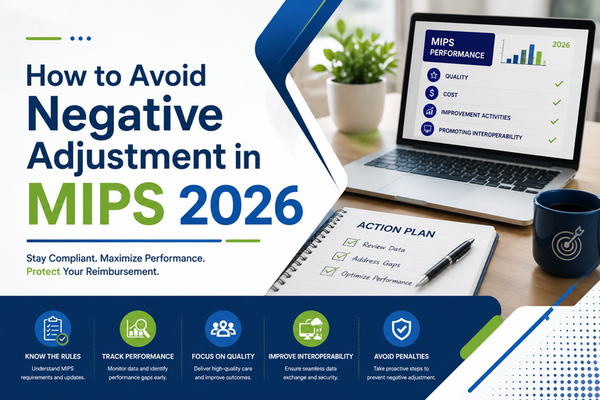
Your overall MIPS score is based on four performance categories:
A higher score can lead to positive payment adjustments and incentive opportunities, while poor performance can result in payment reductions.
Why Avoiding a Negative MIPS Adjustment Matters
A negative MIPS adjustment can affect your practice in various ways:
- Reduced Medicare reimbursements
- Lower annual revenue
- Decreased profitability
- A reputation for poor quality performance
- Loss of incentive opportunities
- Increased administrative burden
Avoiding penalties protects both your financial health and your reputation as a high-quality healthcare provider.
Common Reasons Practices Receive Negative MIPS Adjustments
Many practices lose valuable points because they:
- Wait until the end of the reporting period
- Submit incomplete performance data
- Choose unsuitable quality measures
- Fail to document improvement activities
- Underutilize their electronic health record (EHR) system
- Ignore cost performance trends
- Miss CMS submission deadlines
- Have inaccurate clinical documentation
Fortunately, these issues can be avoided with proper planning.
1. Understand MIPS Eligibility Early
The first step is to determine whether your clinicians are required to participate in MIPS.
Review factors such as:
- Medicare Part B billing volume
- Number of Medicare beneficiaries
- Covered professional services
- Clinician eligibility status
Knowing participation requirements in advance allows you sufficient time to prepare.
2. Select the Right Quality Measures
The Quality category typically accounts for a significant portion of your overall MIPS score. It is crucial to choose measures that align with your specialty and patient population.
When selecting measures:
- Focus on those relevant to your clinical practice.
- Ensure your electronic health record (EHR) system can capture the required data.
- Monitor performance on a monthly basis.
- Prioritize measures with a strong performance history.
Consistent monitoring allows you to identify and address deficiencies before the reporting deadline.
3. Improve Clinical Documentation
Accurate documentation supports both quality reporting and proper coding.
Best practices include:
- Thoroughly documenting patient encounters.
- Recording diagnoses using current ICD-10 codes.
- Ensuring CPT coding corresponds to the services provided.
- Recording all required clinical elements.
- Reviewing documentation for accuracy before submitting the claim.
Robust documentation reduces reporting errors and improves overall performance.
4. Maximize Promoting Interoperability Performance
The Promoting Interoperability category evaluates how effectively your practice uses certified electronic health record (EHR) technology.
Improve your score by:
- Encouraging patient portal use.
- Using e-prescribing.
- Electronically exchanging health information.
- Conducting medication reconciliation.
- Supporting secure messaging with patients.
Training staff on EHR system workflows can significantly improve performance.
5. Complete Improvement Activities
Improvement activities reward practices that implement processes to optimize patient care and operational efficiency.
Examples include:
- Care coordination programs
- Chronic disease management
- Patient safety initiatives
- Telehealth services
- Population health management
- Patient engagement programs
- Expanded access to care
Many small practices can earn full credit by completing the required activities and maintaining appropriate documentation.
6. Monitor Cost Performance Throughout the Year
Although CMS calculates costs using Medicare claims data, practices can influence performance through the efficient delivery of care.
Strategies include:
- Reducing unnecessary tests
- Coordinating specialist referrals
- Preventing avoidable hospitalizations
- Proactively managing chronic conditions
- Following evidence-based treatment guidelines
Effective care coordination improves patient outcomes while simultaneously reducing healthcare costs.
7. Conduct Monthly Performance Reviews
Do not wait until the end of the year to evaluate your MIPS performance.
Instead, review key metrics on a monthly basis, including:
- Quality measure performance
- Documentation accuracy
- Claim acceptance rates
- Patient outcomes
- Preventive care compliance
- Chronic disease management metrics
Regular reviews help identify issues early and allow for corrective action.
8. Train Providers and Staff
Success in MIPS depends on the collaboration of the entire practice team.
Training should cover:
- Documentation requirements
- Workflows for quality measures
- Use of the electronic health record (EHR)
- Coding accuracy
- Patient communication
- Care coordination
- Data collection procedures
A well-informed team contributes to better overall performance.
9. Use Data Analytics to Identify Gaps
Performance dashboards provide valuable insights into areas requiring improvement.
Track indicators such as:
- Blood pressure control
- Diabetes management
- Preventive screenings
- Follow-up appointments
- Vaccination rates
- Patient engagement
- Hospital readmissions
Proactive use of data helps care facilities improve prior to reporting deadlines.
10. Perform Internal Audits
Routine audits help ensure compliance and reduce reporting errors.
Internal reviews should evaluate:
- Coding accuracy
- Clinical documentation
- Performance on quality measures
- Electronic health record (EHR) data integrity
- Evidence of improvement activities
- Reporting readiness
Audits provide an opportunity to correct issues before final reports are submitted.
11. Meet Every CMS Reporting Deadline
Failure to meet submission deadlines can result in automatic sanctions, regardless of performance.
Create a compliance schedule that includes tracking for:
- Data collection periods
- Internal review dates
- Documentation deadlines
- CMS submission deadlines
- Performance review meetings
Staying organized minimizes the risk of non-compliance.
12. Partner with Experienced MIPS Consultants
Many practices choose to work with experienced consultants specializing in MIPS reporting and compliance.
Professional support can assist with the following:
- Eligibility assessment
- Measure selection
- Documentation improvement
- Workflow optimization
- Performance monitoring
- Data validation
- Submission of information to CMS
- Ongoing compliance
Expert guidance often leads to better scores and a reduced administrative burden.
Common Mistakes to Avoid
Avoid these common MIPS reporting errors:
- Waiting until the end of the year to prepare
- Selecting measures that do not align with your specialty
- Incomplete clinical documentation
- Ineffective use of the electronic health record (EHR) system
- Overlooking performance in the Cost category
- Failing to document improvement activities
- Not reviewing performance reports
- Missing submission deadlines
Avoiding these errors can significantly improve your final score.
How ESOFTX, Inc. Helps Practices Succeed in MIPS
At ESOFTX, Inc., we offer comprehensive MIPS consulting and performance improvement services to healthcare providers across New York State and throughout the United States.
Our services include:
- MIPS eligibility assessment
- Quality measure selection
- Performance monitoring
- Clinical documentation improvement
- Workflow optimization
- EHR (Electronic Health Record) reporting support
- Documentation of improvement activities
- Internal compliance audits
- Assistance with CMS data submission
- Ongoing performance consulting
Our experienced team collaborates closely with medical facilities to reduce compliance risks, improve quality scores, and maximize Medicare reimbursements.
Best Practices for Long-Term MIPS Success
To maintain strong MIPS performance year after year:
- Continuously monitor quality measures.
- Invest in staff training.
- Optimize electronic health record (EHR) workflows.
- Engage patients through digital tools.
- Conduct periodic documentation audits.
- Review CMS updates annually.
- Use data-driven quality improvement strategies.
- Collaborate with compliance experts.
A proactive approach leads to sustained performance and financial stability.
Conclusion
Avoiding a negative MIPS payment adjustment in 2026 requires preparation, accurate documentation, continuous performance monitoring, and a commitment to quality improvement. Medical practices that adopt a proactive approach can not only avoid penalties but also position themselves to secure positive payment adjustments and achieve better patient outcomes.
ESOFTX, Inc. is dedicated to helping healthcare providers confidently navigate the complexities of MIPS reporting. From selecting the right quality measures to optimizing workflows and ensuring timely submissions to CMS, our experts provide the guidance needed to protect revenue and achieve long-term success within the value-based care model.
If your practice is preparing for MIPS 2026, partnering with an experienced consulting team can make the difference between a penalty and a high-performance score that bolsters both regulatory compliance and profitability.
Frequently Asked Questions (FAQs)
1. What causes a negative MIPS payment adjustment?
Low performance scores, incomplete data submission, poor documentation, failure to carry out improvement activities, and failure to meet CMS deadlines are frequent reasons.
2. Can small practices avoid MIPS penalties?
Yes. By selecting the appropriate measures, periodically monitoring performance, maintaining accurate documentation, and submitting complete data, small practices can avoid negative adjustments.
3. How often should MIPS performance be reviewed?
Monthly reviews are recommended to identify performance gaps early and implement corrective actions before the reporting period ends.
4. Does EHR optimization improve MIPS scores?
Without a doubt. The appropriate use of certified electronic health record technology (CEHRT) supports the promotion of interoperability, improves documentation quality, and increases data accuracy for reporting purposes.
5. How can ESOFTX, Inc. help with MIPS 2026?
ESOFTX, Inc. offers comprehensive MIPS consulting services ranging from eligibility assessment and measure selection to workflow optimization, documentation review, performance monitoring, and support with CMS data submission to help practices avoid penalties and maximize Medicare reimbursements.
