


How Small Practices Can Get a Positive MIPS Payment Adjustment in 2026
Before designing a strategy to secure a positive MIPS payment adjustment, it is important to clarify a detail regarding timelines that often confuses many practices: the 2026 MIPS performance year does not affect Medicare payments for that same year; instead, it determines the payment adjustment two years later, in 2028. What small practices must prioritize right now in order to achieve a positive adjustment when it is finally applied is the information they submit and the score they earn throughout 2026. This guide addresses precisely that aspect.
1. Know the Number You're Actually Chasing
CMS has confirmed that the MIPS performance threshold remains at 75 points for the 2026 performance year and is slated to remain in place through the 2028 performance period. Exceeding the 75-point score makes one eligible for a positive adjustment; hitting that exact figure results in a neutral outcome; and falling below it triggers a negative adjustment based on a sliding scale that can reach as low as -9%. That 75-point threshold is the key factor: any strategy falling short of that figure should be viewed as a means to surpass it comfortably, rather than just barely scraping by.
2. Understand Why "Comfortably Above" Matters More Than "Above"
By law, MIPS is a budget-neutral program; this means CMS applies an adjustment factor to positive bonuses to ensure that total payouts do not exceed total penalties collected. In practice, this has reduced the magnitude of positive adjustments in recent years, even as more professionals surpass the established threshold: national performance is heavily concentrated just above the 75-point mark, compressing the reward. The practical implication for small practices is clear: simply clearing the 75-point threshold by a narrow margin is not enough. Every additional point above that threshold is now more significant than when the incentive pool was larger, as competition is based on the national distribution of results rather than a fixed reward.
3. Protect Your Score in the Categories Weighted Heaviest
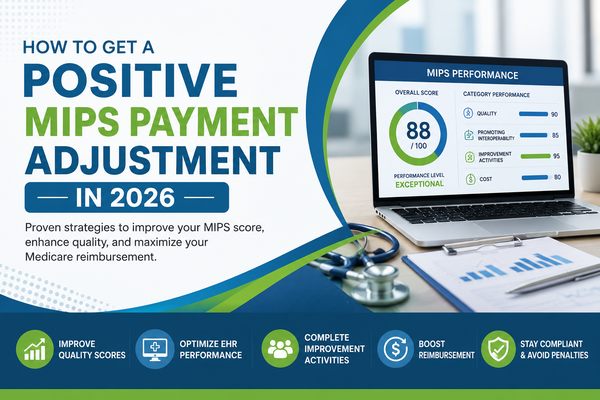
For 2026, category weightings remain unchanged: Quality and Cost are each weighted at 30%, Promoting Interoperability (PI) at 25%, and Improvement Activities (IA) at 15%. Given that Quality and Cost together account for 60% of your final score, minor inconsistencies in either category can have a disproportionately negative impact. Quality measure selections should be reviewed against current-year specifications rather than simply carried over from a previous year; likewise, the Cost component which CMS calculates automatically from claims data should be monitored via feedback reports throughout the year, rather than being revealed only after the performance period has closed.
4. Use Small Practice Protections You're Already Entitled To
Small practices automatically receive a weight redistribution for the Promoting Interoperability (PI) category; this shifts that 25% to other components of the scoring formula rather than penalizing practices unable to fully report PI measures. If your practice qualifies, verify that this redistribution is being correctly applied to your data submission: it is a built-in advantage that is sometimes overlooked during the reporting process, and in most cases not something that requires a separate request.
5. Don't Wait Until Q4 to Check Your Trajectory
The most common reason practices miss the opportunity to secure a positive adjustment is not poor care, but rather realizing too late that their score is trending toward the threshold rather than comfortably exceeding it. Conducting a mid-year review of performance on quality measures, completion of Improvement Activities (IA), and certification status for Promoting Interoperability (PI) gives you time to make adjustments. Waiting until the final weeks of the performance period to reconcile these categories often means that any identified deficiencies can no longer be remedied.
6. Report Every Bonus Point You're Eligible For
Your final score includes the ratings from each category plus any additional bonus points for which you are eligible, such as the bonus for high-complexity patients. Small practices serving patient populations with greater clinical or social complexity should ensure this bonus is recorded; it is an aspect often overlooked simply because it does not automatically appear in most reporting workflows.
7. If Something Looks Wrong After Submission, You Have Options
If your performance feedback report shows a score that does not reflect what you actually submitted for example, a denominator that was not correctly reduced, data submitted with an incorrect TIN or NPI, or a special status not reflected in the scoring a targeted review allows you to formally request that CMS re-examine the calculation. This will not turn a genuinely low score into a positive one, but it protects you against scoring errors unrelated to your actual performance.
The Bottom Line
Achieving a positive payment adjustment for the 2026 performance year depends on two factors: exceeding the 75-point threshold with a safety margin and doing so through consistent, well-documented reporting, rather than attempting a last-minute scramble at year-end. For small practices specifically, built-in safeguards such as PI reweighting, bonus points, and targeted review exist precisely because CMS recognizes that smaller teams have less margin for error. Proactively leveraging these measures, rather than relying on them to apply automatically, often makes the difference between a neutral adjustment and a positive one.
ESOFTX, Inc. helps practices manage MIPS reporting, PCMH transformation, HEDIS measures, and compliance with value-based care models throughout the year. If you would like a mid-year review of your MIPS trajectory for 2026, we would be happy to assist you.
