

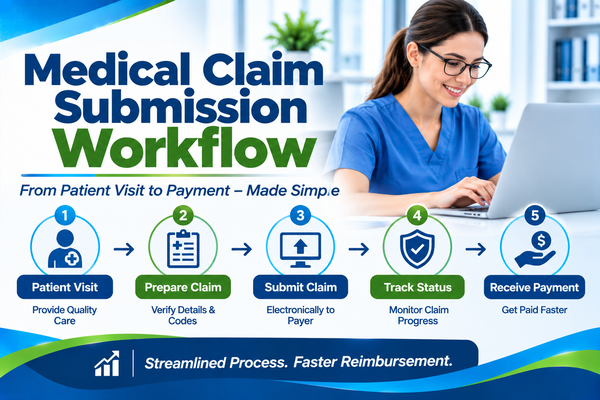
Most medical facilities consider the claims submission process to begin the moment someone clicks "submit." In reality, that click occurs halfway through the process, not at the start. The quality of a claim is determined by what happens even before the patient arrives at the facility, while the speed of reimbursement depends on what takes place after the claim leaves the system. A reliable medical claims workflow connects every stage, making it possible to detect errors early, ensure that claims are submitted without flaws, and guarantee that payments are received without the need for repetitive, additional work. This guide examines each stage, explains what to review at every phase, and highlights the points where most medical facilities lose money.
Why the Workflow Matters More Than the Submission
Every error that reaches a payer incurs costs in terms of both time and money. A rejected claim must be corrected and resubmitted, while a denied claim requires investigation, an appeal, or write-off. Even a minor error such as transposing a single digit in a member’s identification number can delay payment for weeks. Healthcare facilities that view claims submission as an integrated workflow, rather than an isolated task, typically experience fewer rejections, receive faster payments, and lower their administrative costs. The goal is to achieve a high "clean claim rate" that is, a high percentage of claims that are approved and paid upon their initial submission. Many revenue cycle teams aim for a rate of 95% or higher, though the specific target will depend on the medical specialty and the mix of payers involved.
The Claim Submission Workflow at a Glance
| Stage | Core Task | Main Risk If Skipped |
|---|---|---|
| 1. Scheduling and registration | Capture accurate patient and insurance data | Demographic and ID errors |
| 2. Eligibility and authorization | Verify coverage and obtain approvals | Eligibility and authorization denials |
| 3. Check-in and documentation | Collect copays, complete clinical notes | Missing or weak documentation |
| 4. Charge capture and coding | Translate care into CPT, HCPCS, and ICD-10 codes | Coding errors and lost revenue |
| 5. Claim creation and scrubbing | Build the claim and run edits | Preventable rejections |
| 6. Submission and acknowledgment | Transmit and confirm receipt | Lost or unprocessed claims |
| 7. Payment posting | Post payments and adjustments | Underpayments go unnoticed |
| 8. Denial and A/R follow-up | Work rejections, denials, and aging claims | Revenue written off by default |
| 9. Patient billing and reporting | Bill balances, track metrics | Slow collections, hidden problems |
Stage 1: Scheduling and Patient Registration
The workflow begins the moment an appointment is scheduled. Front-desk staff must collect the patient’s full legal name exactly as it appears on their insurance card along with their date of birth, address, phone number, and complete insurance information, including the policyholder’s name, member ID number, group number, and the name of the insurance carrier. If a patient has more than one plan, it is necessary to identify which is primary and which is secondary. During a patient’s first visit, both sides of their insurance card and a photo ID must be scanned or photographed; for follow-up visits, staff should verify whether any information has changed.
A surprising percentage of claim denials stem from the registration process such as a misspelled name, an incorrect date of birth, or an outdated policy number. Correcting this information at this stage takes only a few seconds, whereas doing so after a denial has occurred can take days.
Stage 2: Eligibility Verification and Prior Authorization
Before the visit, confirm that coverage is active for the date the service will be provided. Use the payer’s portal or your system’s real-time eligibility verification tool typically based on the standard electronic eligibility transaction to verify the following:
- Coverage validity and plan type.
- Applicable copayment, deductible, and coinsurance amounts.
- Whether the service is covered.
- Referral and prior authorization requirements.
- Whether the provider delivering the service is in-network or out-of-network.
- If a procedure, diagnostic imaging study, or specialist referral requires prior authorization, obtain it before the service is provided and record the authorization number in the patient’s account. Issues related to authorization and eligibility are among the most frequent causes of claim denials; they are also among the easiest to prevent, as the information is available before the claim is generated.
Stage 3: Check-In, Documentation, and Point-of-Service Collections
During the admission process, reconfirm demographic data and insurance information, collect any copayments, and indicate any amounts estimated to be the patient's responsibility. Following the consultation, the healthcare professional must complete the clinical documentation without delay. The clinical record serves as the legal and financial basis for the claim; it must justify the services billed, the diagnoses reported, and the medical necessity of the care provided. Incomplete, unsigned, or imprecisely written records cause delays in medical coding and create regulatory compliance risks. Establishing an internal deadline for example, requiring documentation to be completed within one business day helps expedite the claims processing workflow.
Stage 4: Charge Capture and Medical Coding
Charge capture converts the care provided into billable items. Uncaptured charges represent a loss of revenue that cannot be recovered, regardless of any subsequent follow-up efforts. Healthcare facilities must reconcile their daily schedules with captured charges to ensure that every patient encounter has a corresponding charge.
Subsequently, the medical coding process transforms documentation into standardized codes: CPT or HCPCS codes for services, and ICD-10-CM codes for diagnoses. Accuracy at this stage is critical. Each procedure must be linked to a diagnosis that justifies its medical necessity, and modifiers must be applied correctly. Coding staff must stay up to date with annual updates to coding systems, specific payer policies, and code-bundling rules. In cases of ambiguous documentation, it is necessary to seek clarification from the healthcare provider before generating a claim, rather than attempting to guess the information.
Stage 5: Claim Creation and Scrubbing
Once charges have been coded, your billing system generates the claim. Claims for professional services are typically prepared using the CMS-1500 dataset and transmitted electronically in the 837P format, while claims from healthcare facilities use the UB-04 dataset and the 837I format. Before a claim leaves your system, it must undergo a validation process known as "claim scrubbing" which is an automated review that checks the claim against a set of pre-established rules. An effective validation system detects issues such as:
- Missing or invalid patient or subscriber information.
- Inconsistencies between diagnoses and procedures.
- Missing or invalid modifiers.
- Errors in provider identifiers, including issues with the NPI (National Provider Identifier) or taxonomy.
- Duplicate charges.
- Services that conflict with a payer’s "bundling" rules.
- Missing authorization numbers.
- Validation rules should be reviewed periodically, as payer requirements change. Many teams also incorporate a brief human review for high-dollar claims, even when those claims pass the automated validation process.
Stage 6: Submission, Clearinghouse Transmission, and Acknowledgments
Most medical practices submit their claims through an intermediary entity a "clearinghouse" which verifies the format, routes each claim to the appropriate payer, and provides status reports. After submitting a batch, you will receive a series of confirmation notifications; it is important to learn how to interpret them:
- File-level confirmation: Confirms that the clearinghouse has received and accepted the file structure.
- Clearinghouse validations: Identify claims that do not meet the required format or the specific rules of the payer. These are considered rejections.
- Payer confirmation: Confirms that the payer has accepted the claim for processing, or has rejected it due to initial errors.
A common and costly mistake is assuming that a claim has reached the payer simply because it has left your system. Review rejection reports daily, correct any errors immediately, and whenever possible resubmit the claim that same day. Additionally, keep track of submission deadlines. For example, Medicare typically requires claims to be submitted within one calendar year from the date of service, while many commercial payers and Medicaid have much shorter timeframes. Consult your contract with each payer and retain proof that the submission was made within the established deadline.
Rejections Versus Denials: Know the Difference
Although both terms are often used interchangeably, they require different responses.
A "rejection" means that a claim failed initial validation and never reached the payer’s formal evaluation process. It has neither been paid nor denied; typically, it can be corrected and resubmitted without the need for an appeals process.
A "denial" means that the payer processed the claim and decided not to pay for all or part of it. A denial generally requires investigation, correction, or the submission of a formal appeal within the timeframe established by the payer.
Tracking these two concepts separately helps identify where the workflow is breaking down. High rejection rates point to issues with initial data or pre-verification processes. High denial rates indicate deficiencies related to eligibility, authorization, coding, or documentation.
Stage 7: Payment Posting and Reconciliation
When a payer processes a claim, it issues an electronic remittance advice typically in an 835 format detailing which amounts have been paid, adjusted, denied, or assigned to the patient. Payment posting involves recording these amounts to the patient’s account. Accurate posting does more than just update balances; it allows for the comparison of received payments against agreed-upon rates, making it possible to identify underpayments. Medical practices that handle posting carelessly, or that rely on automated posting systems without oversight, often overlook underpayments, as the mere receipt of a payment rarely triggers an alert.
Periodically reconcile received deposits with recorded payments to ensure that every dollar collected is allocated to the correct account.
Stage 8: Denial Management and A/R Follow-Up
Not all claims will be paid on the first submission; therefore, a rigorous follow-up process is an integral part of the workflow not something to be addressed as an afterthought. Effective follow-up includes:
- Managing rejections on the same day they occur.
- Categorizing denials by reason code and payer to identify patterns.
- Submitting appeals for valid denials, including all necessary documentation and adhering to established deadlines.
- Checking the status of claims for which no response has been received after a reasonable period for example, 30 days.
- Prioritizing outstanding accounts based on the risk of them becoming overdue and their monetary value.
- Identifying the root cause of each denial and correcting it at the beginning of the process. If a payer repeatedly denies a service due to a lack of authorization, the true solution is to secure that authorization during the admission phase, rather than repeatedly filing appeals.
Stage 9: Patient Billing and Performance Reporting
Once the insurance company has made its payment, the remaining balance becomes the patient's responsibility. Send clear statements, offer convenient payment options, and establish payment plans for larger balances. Many practices also benefit from estimating patient costs before providing services and collecting payment at the time of care.
Finally, evaluate your workflow. Review the following indicators on a monthly basis:
- Clean claim rate (claims accepted on the first submission, without errors)
- Rejection and denial rate
- Days in accounts receivable
- Percentage of accounts receivable older than 90 days
- Net collection rate
- Average number of days from the date of service to claim submission
Trends in these figures will indicate which stage requires attention. For example, an increase in the denial rate suggests that eligibility verification and authorization procedures need to be reviewed.
Common Workflow Mistakes to Avoid
- Skipping eligibility checks for returning patients
- Leaving charges unbilled for days or weeks
- Relying solely on automated reviews without verifying established rules
- Failing to monitor rejection reports on a daily basis
- Not tracking claim submission deadlines according to the specific payer
- Recording payments without comparing them against contractually agreed-upon rates
- Treating denials as isolated incidents rather than as patterns
Building a Workflow That Lasts
The most robust workflows for claims submission share certain characteristics: a clear assignment of responsibilities at each stage, documented procedures, daily checkpoints, and measurable goals. It is essential to assign someone to be responsible for each step, document how tasks should be performed, review key metrics on a weekly basis, and update the process whenever payer rules or code sets change. When a medical practice or center is short-staffed or struggles with claim denials, partnering with a specialized medical billing company can provide added capacity, expertise, and consistency without the costs associated with building a large in-house team.
The Takeaway
The claims submission process is not a single, isolated task; it is a chain of interconnected steps, and the strength of that chain depends on its weakest link. Accurate registration, thorough eligibility and authorization checks, robust documentation, precise coding, effective error scrubbing, daily management of rejections, meticulous payment posting, and rigorous follow-up all these elements work together to ensure error-free claims and accelerate collections. Medical practices that establish and oversee this workflow protect their revenue, minimize the need for redundant tasks, and allow their teams to focus on patient care.
ESOFTX, Inc., a medical billing company based in Levittown, New York, helps medical practices optimize claims submission, reduce rejections and denials, and improve revenue cycle performance. If you would like an assessment of your current claims submission workflow, our team is here to help.
