


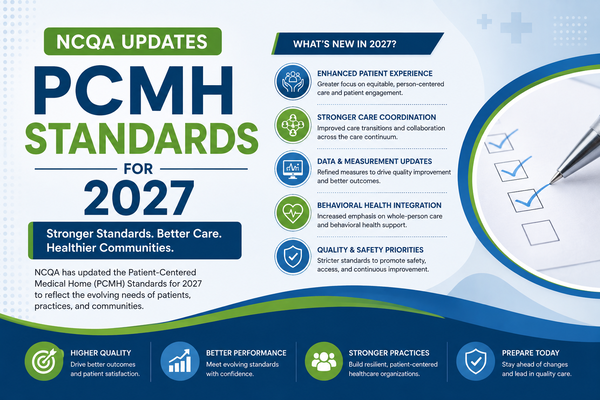
NCQA Updates PCMH Standards for 2027: What Practices Need to Know
On July 1, 2026, the NCQA released updated standards and guidelines for the Patient-Centered Medical Home (PCMH) model, with changes taking effect on January 1, 2027. Unlike some previous updates that addressed multiple concepts simultaneously, this revision focuses almost exclusively on one area: Care Management (CM) specifically, how practices identify patients for care management, enroll them, and document their care plans. For practices that already hold PCMH accreditation and those seeking to obtain it, this targeted focus simplifies planning for the update, though implementing it correctly remains critically important.
A Reminder Before the Details: You're Always on the Current Version
All practices recognized as PCMHs must comply with the latest standards and guidelines, regardless of the version under which they initially obtained recognition. This means that the 2027 updates apply to your practice whether you are just beginning the transformation process or have held recognition for years; there is no option to remain under a previous, more familiar version of the criteria.
What's Changing: Care Plan Documentation
The most tangible change in daily workflows lies in what a documented care plan must include from now on. Such plans must reflect an anticipated clinical outcome alongside either a patient treatment goal or a SMART goal; care centers now have the flexibility to choose between these formats rather than being bound to a single one. Additionally, care plans must include a follow-up date or a defined timeframe for review and updating. The inclusion of SMART goals as a valid option aims to offer centers greater flexibility when documenting outcomes, while maintaining a focus on measurable, patient-centered aspects rather than merely a vague treatment intention.
What's Changing: Identifying and Monitoring Patients for Care Management
The proposed and final updates also address how practices initially identify patients requiring care management; to this end, criteria are refined across categories such as behavioral health disorders, high-cost or high-utilization cases, complex or poorly controlled conditions, social determinants of health, and referrals from external organizations. For pediatric practices, the requirement was made more flexible shifting to a mandate for meeting criteria in at least two categories rather than three thereby acknowledging that the pediatric population does not fully align with criteria designed primarily around chronic disease patterns in adults.
What's Being Retired
As part of the optimization of the Care Management and Support concept, an existing optional criterion is being removed from the list of options practices can use to fulfill the required 25 optional credits. Practices currently earning credits through that criterion must identify a replacement option before their next reporting cycle to maintain their total credit count.
A Related Operational Change: Multi-Site Sampling Requests
Regardless of updates regarding care management, the NCQA is tightening the timelines for multi-site sampling requests. Starting January 1, 2027, organizations requesting such sampling must submit their applications at least six months prior to the reporting date, rather than relying on the more flexible deadlines permitted by the NCQA during the initial implementation period. Multi-site organizations should incorporate this requirement into their annual reporting now to avoid facing a tighter deadline when the request is already overdue.
Why the Focus on Care Management Specifically
Care management has long been one of the most subjective areas in the evaluation of the Patient-Centered Medical Home (PCMH) model; practices serving highly diverse patient populations have had to apply the same identification and documentation criteria, which do not always align well with different specialties, case mixes, or the differences between pediatric and adult patients. The 2027 updates directly address this discrepancy: they clarify the requirements a patient must meet to access care management, offer greater flexibility in how outcomes are documented, and adjust expectations for practices whose patient populations do not resemble the standard adult chronic disease care model upon which the criteria were originally designed.
How Practices Should Prepare Before January 1
The updates will not take effect until January 1, 2027, but now is the time to prepare. Care centers should:
- Review current care management workflows based on the new patient identification categories.
- Update internal policies and procedures to reflect revised care plan documentation requirements, including the option to set SMART goals.
- Confirm that electronic medical record (EMR) templates and fields allow for recording a follow-up date or review timeframe for each care plan.
- Identify an alternative option if your center currently relies on a criterion that is being eliminated.
- Incorporate the new multi-site sampling request schedule (with a six-month timeframe) into the compliance calendar, if applicable.
Downloading current PCMH standards and guidelines directly from the NCQA rather than working from a saved older version remains the most reliable way to ensure your center is working toward meeting the correct requirements.
The Takeaway
The NCQA’s 2027 update to the PCMH model is more limited in scope than some previous revisions, yet it focuses directly on one of the program's most critical operational aspects: the processes for identification, enrollment, and documentation related to care management. Practices that begin reviewing their workflows and electronic medical record (EMR) system capabilities now rather than waiting for the January 1st effective date will experience a much smoother transition than those forced to scramble to adjust their documentation after the fact.
ESOFTX, Inc. helps practices stay up to date with PCMH standards, MIPS reporting, HEDIS measures, and compliance with value-based care models. If you would like assistance reviewing your care management workflows prior to the implementation of the 2027 changes, we would be happy to help.
