


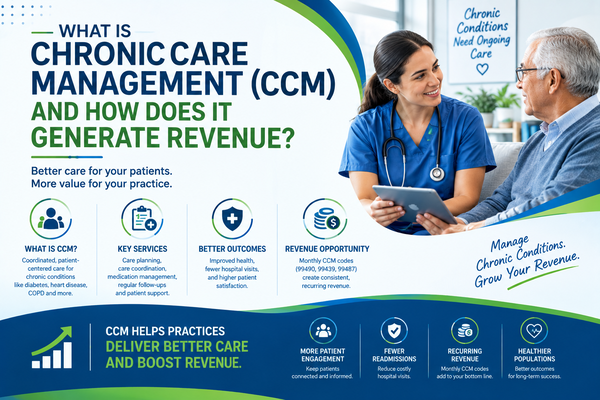
What Is Chronic Care Management (CCM) and How Does It Generate Revenue?
Most practices already perform the activities covered by Chronic Care Management (CCM); they just don't bill for them. Medication reconciliation between visits, coordination with specialists, follow-up on lab results, and contact with patients managing multiple chronic conditions constitute routine care coordination that occurs outside the exam room and is a billable service under Medicare Part B. For practices that haven't yet formalized a CCM program, this represents a largely untapped source of recurring revenue. Below is an explanation of what CCM actually is, how billing works, and the corresponding revenue figures.
What Is Chronic Care Management?
CCM is a Medicare Part B program that reimburses practices for non-face-to-face care coordination provided to patients with two or more chronic conditions expected to last at least 12 months (or until the patient's death) and that pose a significant risk of deterioration, hospitalization, or death. Common qualifying conditions include diabetes, hypertension, COPD, heart failure, chronic kidney disease, and depression conditions requiring ongoing management between appointments, rather than just treatment during visits.
The service encompasses activities such as:
- Developing and maintaining a comprehensive, patient-centered care plan
- Medication management and reconciliation
- Coordinating care with specialists, home health services, and other providers
- 24/7 access for urgent needs related to chronic conditions
- Systematic patient monitoring between visits
This work may be performed by clinical staff under the general supervision of a physician, or directly by the physician or a qualified healthcare professional; both approaches can be billed separately using distinct CPT codes.
The CPT Codes That Generate CCM Revenue
CCM billing is based on a family of time-determined CPT codes, and understanding which code corresponds to each situation is the basis for correctly generating CCM revenue:
Non-complex CCM (clinical staff-directed):
- CPT 99490 — The first 20 minutes of clinical staff time per calendar month, under general supervision.
- CPT 99439 — Each additional 20-minute period beyond the first, billable up to twice a month as an add-on to code 99490.
Non-complex CCM (physician or qualified health professional-directed):
- CPT 99491 — First 30 minutes of direct time by the physician or qualified healthcare professional (QHP).
- CPT 99437 — Each additional 30 minutes, billed as a supplementary service to code 99491.
Complex CCM:
- CPT 99487 — The first 60 minutes of clinical staff time dedicated to patients requiring moderate- or high-complexity medical decision-making and a substantial review of the care plan.
- CPT 99489 — For each additional 30 minutes (add-on to code 99487), with no monthly limit on units.
Reimbursement is determined by the Medicare Physician Fee Schedule and varies by geographic area, but national averages provide a useful benchmark: code 99490 reimburses approximately $60 to $66 per patient per month; the 99439 add-on, between $45 and $50; and complex chronic care management (CCM) under code 99487 typically ranges from $130 to $144 for the first 60 minutes. A separate program, Advanced Primary Care Management (APCM, billed under HCPCS code G0557 and related codes), offers monthly, complexity-based bundled payments as an alternative to time-based billing, designed for practices that prefer to reduce the administrative burden of documentation associated with minute-by-minute tracking.
How the Revenue Actually Adds Up
Calculating revenue from CCM (Chronic Care Management) is straightforward, yet the total accumulates faster than most practices anticipate, as it is a recurring monthly service rather than a one-time billed consultation. A single non-complex CCM patient, consistently billed under code 99490, generates approximately $700 to $800 annually. A practice that enrolls 150 eligible patients in the standard CCM program while also accounting for a subgroup qualifying for complex CCM and consistently applying add-on codes can realistically generate recurring annual revenue well into the six-figure range, all without adding a single new patient to the schedule. This revenue is generated entirely from patients the practice is already treating, stemming from care coordination tasks that clinical staff often already perform informally.
Combining CCM with other care management programs such as Remote Patient Monitoring (RPM) or Behavioral Health Integration (BHI) further amplifies this effect, as these services can be billed concurrently for the same patient, provided the time and documentation requirements for each program are met independently.
Why Practices Leave This Revenue on the Table
The concept of the CCM is not complicated, but three operational gaps systematically prevent practices from receiving the income that this model is designed to generate:
Missing the initiating visit. For new CCM patients, an initial visit typically billed using HCPCS code G0506 is generally required before monthly CCM billing can begin. Practices that skip or incorrectly document this step risk having subsequent claims denied.
Undercounting time. Non-complex Chronic Care Management (CCM) requires a minimum of 20 minutes of qualifying care coordination time per month, which must be recorded and documented for each patient. Without a specific workflow or care management platform, it is easy to under-report this time even when the work is actually being performed meaning the practice carries out the tasks without billing for them in full.
Not identifying complex patients correctly. Patients meeting the criteria for complex CCM (codes 99487/99489) generate significantly higher reimbursement than those for non-complex CCM, but only if their care plan and documentation reflect the moderate-to-high complexity medical decision-making required by CMS for that code. Practices that routinely assign all CCM patients to the non-complex category are missing out on actual revenue.
Patient Cost-Sharing
CCM is covered by Medicare Part B, meaning patients typically pay standard 20% coinsurance a monthly amount often covered by supplemental insurance or Medicaid. Setting clear expectations with patients regarding this cost during enrollment helps prevent confusion and maintain high enrollment and retention rates.
The Takeaway
Chronic Care Management (CCM) transforms the care coordination work that most practices already perform into a structured, recurring, and significant revenue stream; however, this only happens when the initial visit, time tracking, complexity classification, and monthly billing cadence are managed correctly and consistently. For practices lacking a dedicated care management workflow, maintaining that internal consistency month after month is often the most challenging aspect.
ESOFTX, Inc. helps practices implement and manage compliant CCM programs covering everything from patient identification and initial visits to monthly time tracking and billing thereby preventing the loss of the recurring revenue CCM is designed to generate due to administrative shortcomings. If your practice is considering implementing CCM or would like a revenue estimate based on your current patient panel, we would be happy to assist you.
