


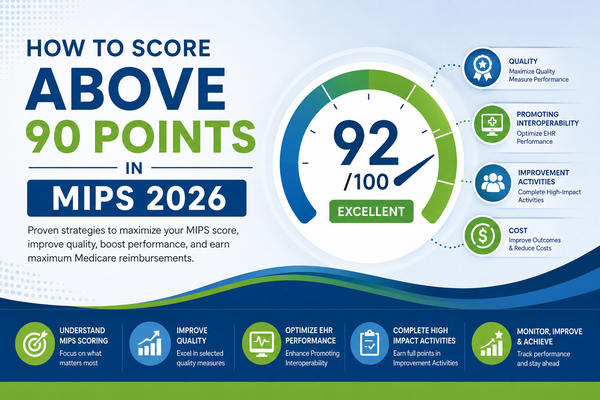
How to Score Above 90 Points in MIPS 2026
For the 2026 calendar year, CMS has kept the MIPS program virtually unchanged from a structural standpoint; however, a lack of change does not mean it is easy. The performance threshold stands at 75 points a figure CMS will maintain through the 2028 performance year while the national median score for physicians tends to fall in the high 80s. This means that, while scoring 75 points allows you to avoid penalties, it no longer puts you ahead of your peers. If your practice seeks a true competitive advantage and the best possible Medicare Part B payment adjustment two years down the line the real goal for 2026 is to achieve a final score above 90.
That is how you get there, category by category.
1. Understand the Category Weights You're Working With
The four MIPS performance categories have the following weights for 2026:
Given that Quality and Cost together account for 60% of your final score, achieving a result above 90 is nearly impossible without solid performance in both areas. Although PI and IA carry less weight, they are also the categories where a well-managed practice can realistically achieve a near-perfect score with minimal effort; therefore, they should not be viewed as secondary elements.
2. Maximize the Quality Category (30%)
Quality is the area where the greatest variability in scoring occurs, and likewise, where documentation gaps cause practices to quietly lose the most points.
- Select measures deliberately, not by default. You need six indicators, including one for outcomes or high priority. Choose indicators for which your practice already performs well and has reliable historical data, rather than those that simply seem appropriate for your specialty.
- Watch the new benchmarking methodology. CMS revised the scoring methodology for certain claims-based measures for the 2026 performance year, aligning them more closely with the benchmarking of cost measures through the use of medians and standard deviations. In practice, some measures now award more points than before for moderate performance levels; therefore, do not assume that last year's scoring criteria remain valid.
- Report a full calendar year of data. Reports covering only part of the year limit your integrity score before you even begin.
- Prioritize an Outcome measure where clinically possible. Outcome measures and high-priority measures offer the possibility of obtaining additional points, unlike process measures.
3. Treat Promoting Interoperability as a Near-Perfect-Score Category (25%)
IP depends largely on the configuration of the electronic health record (EHR) and on workflow discipline rather than on clinical performance making it one of the most controllable categories.
- Confirm that your certified electronic health record technology (CEHRT) meets the 2026 edition requirements.
- Report all mandatory measures: Security Risk Analysis, e-Prescribing, Health Information Exchange, and Provider-to-Patient Exchange—without omissions.
- Pay attention to the recently approved measure: removal policy affecting the Promoting Interoperability (PI) category; this could alter how certain measures impact your score this year.
- If the PI category is not truly applicable to your type of practice, confirm your reweighting or exclusion status in advance, rather than discovering it during the data submission period.
4. Bank Improvement Activities Efficiently (15%)
IA is the category that allows practices to reach the maximum score most quickly. For 2026, the CMS finalized 3 new activities, modified 7, and eliminated 8; therefore, it is advisable to review the current inventory rather than simply reusing the previous year's list from memory. Most practices need only a few high-weight activities to earn full credit in IA, and those related to care coordination or health equity often align with tasks your team is already performing.
5. Don't Ignore Cost — Even Though You Don't "Submit" It (30%)
Cost carries the same weight as quality; however, no data submission is required, as CMS calculates it entirely from claims. This makes it easy to overlook, which is why it warrants attention.
- Currently, CMS evaluates the Cost component using specific measures for MVPs; furthermore, new measures undergo a two-year informational feedback period before affecting your score, giving you time to understand your standing before the results become official.
- Reducing unnecessary service utilization, optimizing care coordination, and avoiding preventable hospital admissions influence this figure, even though there is no specific form to complete.
- Review CMS feedback reports throughout the year rather than waiting for the final score; the Cost component is the category that most practices discover only when it is too late.
6. Consider Whether an MVP Pathway Fits Your Specialty
CMS has finalized six new MIPS Value Pathways (MVPs) for the 2026 performance period, continuing its long-term transition away from the traditional MIPS model. While MVPs are not yet mandatory, they can simplify measure selection for specialty practices and, in certain cases, offer a clearer path to a high score compared to the traditional reporting option. It is worth evaluating whether a suitable MVP already exists for your specialty before opting for the traditional MIPS model again this year.
7. The Real Difference-Maker: Data Accuracy
Across all categories, the primary reason practices score in the 80s rather than the 90s is not clinical performance, but rather incomplete documentation, inconsistent coding, or electronic health record (EHR) data that is not correctly reconciled at the time of submission. A MIPS score above 90 is largely the result of data completeness.
The Bottom Line
Achieving a score of over 90 points in MIPS 2026 isn't about trying to meet every available measure; it’s about selecting the right six Quality measures, executing the PI (Promoting Interoperability) and IA (Improvement Activities) components as precisely as your workflow allows, proactively managing the Cost component throughout the year rather than waiting until the end and maintaining documentation rigorous enough to avoid losing valuable points.
At ESOFTX, Inc., our team partners with medical practices in New York and across the country to audit MIPS readiness, address documentation gaps, and design reporting strategies aimed at achieving scores well above the threshold going beyond merely clearing the bar to avoid penalties. If you would like a complimentary RCM and MIPS readiness audit for your practice, our team is ready to assist you.
